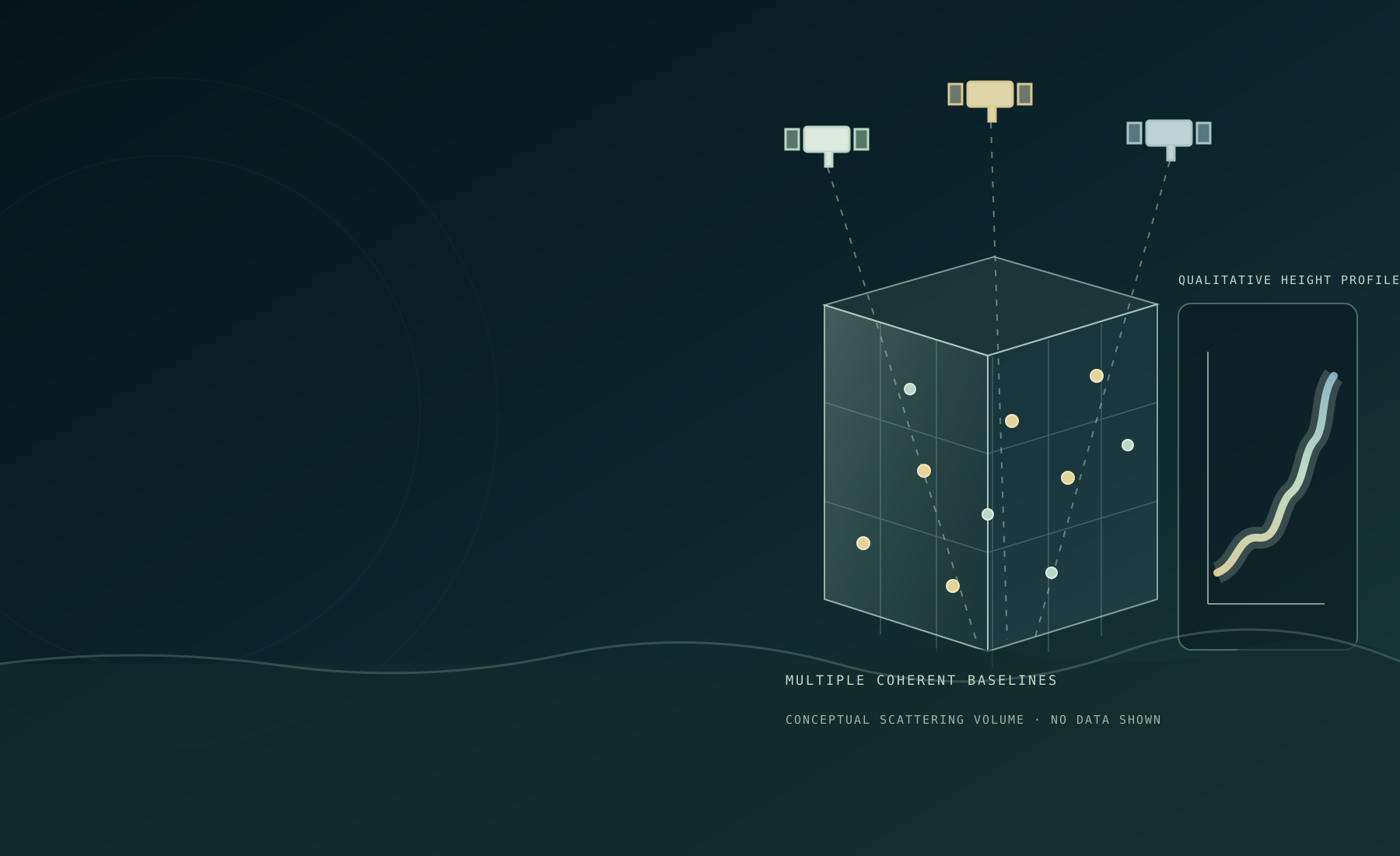
A conventional SAR image places echoes into range and azimuth coordinates. When a target occupies several vertical scattering layers, those contributions can overlap in the image. Tomographic SAR asks whether observations from multiple baselines can separate some of that vertical structure.
Many views constrain a profile
Each acquisition's slightly different orbit creates a different perpendicular baseline and therefore a different phase sensitivity to elevation. A stack of co-registered complex observations can be modelled as samples of a spatial-frequency profile. Tomographic inversion estimates a distribution of scattering power with height rather than a single value. The problem resembles limited-angle tomography: baseline spread, wavelength, signal quality, temporal stability and the distribution of scatterers determine what vertical detail is resolvable.
In forests, returns may arise from canopy, branches, trunks and ground. In dense urban scenes, rooflines and façades can overlap through layover. Tomographic methods can help distinguish components in suitable data, but vertical resolution is finite and the inversion is ill-conditioned. Regularisation or statistical priors stabilise the solution and also influence it; these assumptions must be reported.
What the reconstruction can—and cannot—say
A tomographic profile is a model-based estimate of scattering distribution, not a photograph of the interior of a building or a direct image below ground. Ordinary orbital radar cannot be assumed to reveal arbitrary rooms, tunnels or buried chambers through rock. Subsurface penetration depends on wavelength, material properties, moisture, roughness and geometry, and is limited in many real conditions.
For archaeology and geology, tomography is most responsible when treated as one line of evidence alongside terrain models, optical imagery, geophysics, historical sources and field investigation. It may help pose better hypotheses or characterise a canopy or built structure; it does not certify a hidden feature by itself.