
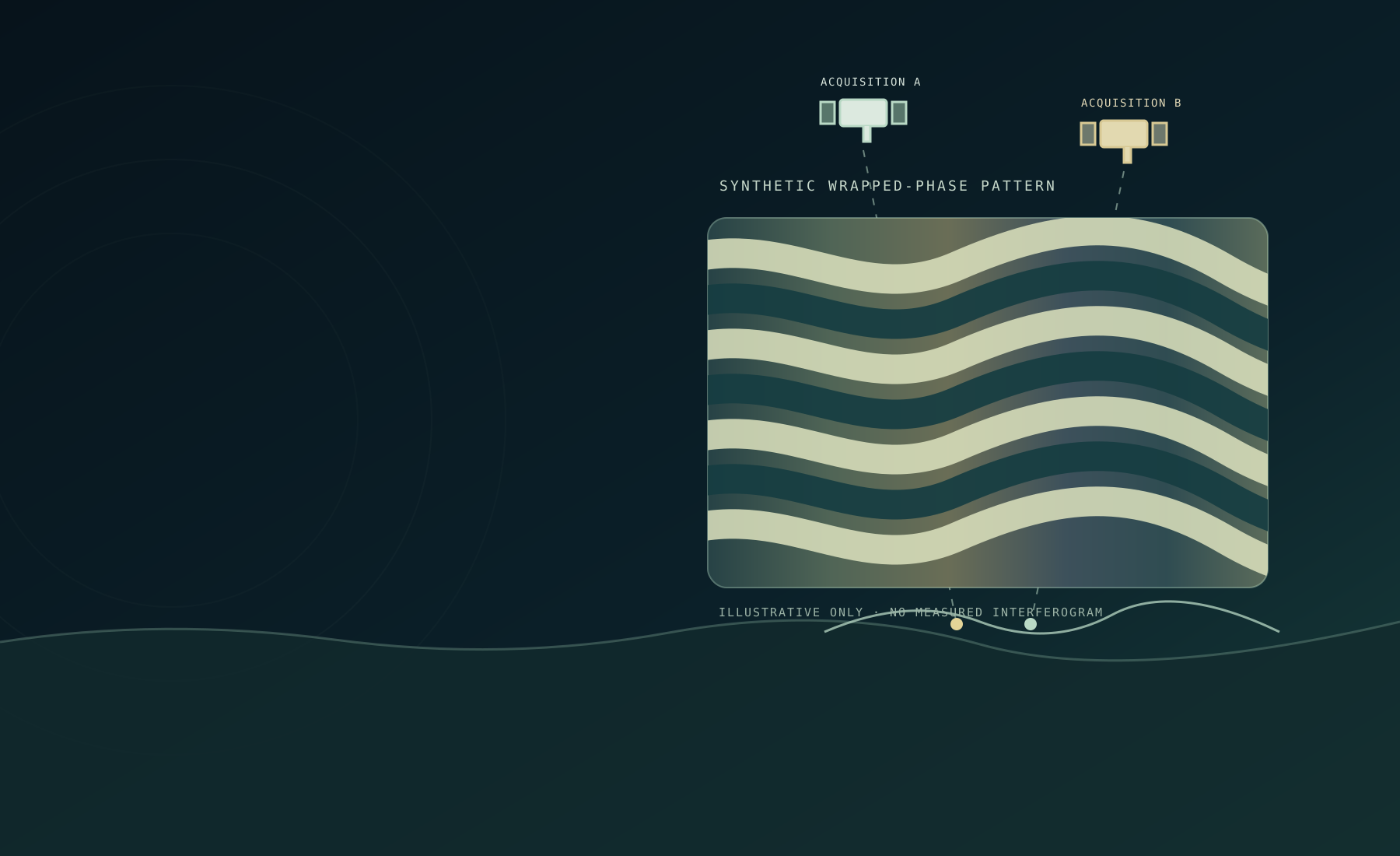
A wave records distance in its phase. If a radar satellite observes the same coherent scatterers twice, a change in the round-trip path can shift that phase. The difference is extraordinarily small, yet measurable across wide landscapes when the geometry and signal remain suitable.
From wave cycle to displacement
For a wavelength λ, a one-way line-of-sight range change ΔR changes the round-trip path by approximately 2ΔR. Under a stated phase convention, the displacement contribution is therefore Δφ ≈ 4πΔR / λ. The sign depends on whether motion toward or away from the sensor is defined as positive. One full phase cycle corresponds to a line-of-sight range change of half a wavelength, not a full wavelength.
The interferometric phase is not pure motion. It can also contain topographic phase from the perpendicular baseline, orbital residuals, atmospheric propagation delay, ionospheric effects at some wavelengths, noise and changes in the scattering surface. Processing co-registers acquisitions, estimates and removes appropriate components, and unwraps phase where possible. Unwrapping attempts to infer the integer number of cycles hidden by phase wrapping; it can fail when noise or discontinuities break the signal.
Coherence: does the landscape still echo the same way?
Interferometric coherence measures the similarity of complex returns between acquisitions. Stable infrastructure and exposed rock can provide persistent phase; leaves moved by wind, changing moisture, snow, cultivation or long time gaps can alter the scattering population and decorrelate it. The perpendicular baseline also changes viewing geometry and can reduce coherence. Multiple acquisitions and time-series approaches help identify persistent patterns, but atmospheric delay and reference choices remain material.
A real interferogram: Yellowstone
The U.S. Geological Survey compared Sentinel-1 observations from 22 September 2020 and 17 September 2021. Its published interferogram indicates up to about 3 cm of subsidence in the central Yellowstone Caldera and about 1.5 cm of uplift in a small area south of Norris Geyser Basin over the image span. This is a documented example of a line-of-sight range-change interpretation, not a ViewPiece result.

Precision is not pixel size
Interferometry can estimate a small phase-related displacement for coherent targets even when that displacement is much smaller than a pixel footprint. That is measurement sensitivity, not the ability to resolve a tiny object or map every point independently. A single viewing direction measures only the line-of-sight component; combining ascending and descending passes or other evidence can improve directional interpretation, but does not automatically yield a full three-dimensional vector.
ESA describes millimetre-scale shifts as measurable with differential InSAR under suitable processing and conditions. Such sensitivity is not a universal guarantee for every surface, acquisition pair or time interval. The displacement signal must be separated from atmosphere, geometry and decorrelation and checked against suitable references.